
Stop assuming Ovulation on Cycle Day 14: your real fertile window (without losing your mind)
If you’ve ever typed “when do I ovulate?” into Google, you’ve probably been told some version of: “Ovulation happens on Day 14.” That’s sometimes true… in a textbook 28-day cycle… in a perfect world… where stress doesn’t exist and your body behaves like a Swiss watch.
Real life is messier.
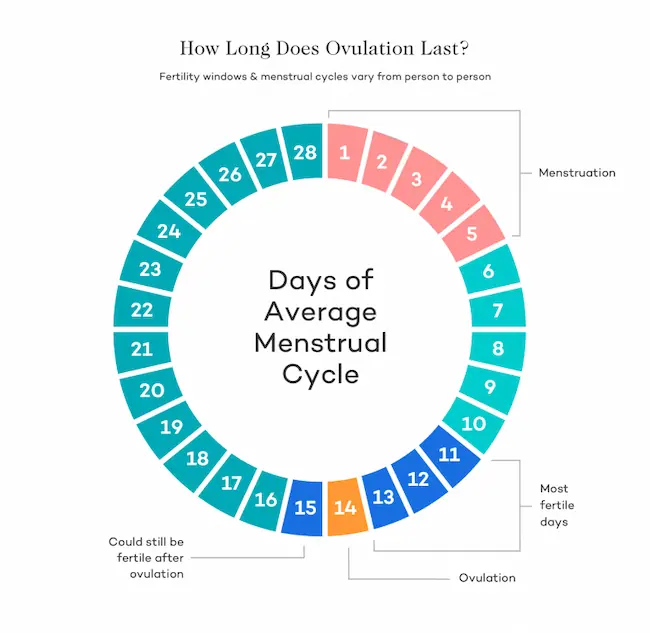
Ovulation is often estimated as ~14 days before your next period, and that timing can vary month to month (yes, even with “regular” cycles).
So let’s clear this up in a way that makes you go: ohhh… that’s what’s been happening.
What your fertile window actually is (and why Day 14 is a trap)
Your fertile window is not “one magic day.” It’s a 6-day window: the 5 days before ovulation + the day you ovulate.
Why?
- Sperm can live up to 3-5 days in the female reproductive tract. The more potent the sperm, the longer they live.
- The egg lives about 12–24 hours after ovulation.
That means your best shot is often before ovulation, not on the exact day.
The #1 timing mistake couples make Waiting for “peak” only.
Waiting for “peak” only.
Many couples see a peak ovulation test, panic, and try to time intercourse only on that peak day (or even after). But the highest chances are typically when sex happens 1–2 days before ovulation because sperm are already waiting when the egg shows up.
Think of it like this:
Ovulation is the concert. Sperm are the people who actually get in because they arrived early and lined up.
The 3-signal method. (simple, reliable, and way less chaotic)
This is how you stop guessing and start knowing your fertile window.
Signal 1: Cervical mucus (your body’s “fertility forecast”)
As estrogen rises, cervical mucus changes. Around your most fertile days it often becomes clear, slippery, stretchy, it’s like raw egg white. This fertile-type mucus commonly shows up for about 3–4 days in many cycles.
How to use it: when you notice slippery/egg-white mucus, treat that as GO TIME.
Signal 2: LH tests (OPKs) (your “heads-up” signal)
OPKs detect the LH surge. Ovulation typically follows within ~1–2 days, though it can vary and may occur anytime within 2 days after the surge.
How to use it (without overcomplicating it):
- Start testing a few days before you expect fertile signs (or when mucus starts changing).
- When it turns positive, think: “ovulation is likely soon” but not “I must only have sex once today or it’s over.”
Signal 3: Basal Body Temperature (BBT) (your confirmation signal)
BBT rises after ovulation (thanks progesterone), usually by about 0.5–1°F (roughly 0.3–0.6°C). BBT does not predict ovulation, but it confirms it after the fact. That’s still incredibly useful because it teaches you your pattern.
How to use it:
- Take temp immediately on waking, same time(ish), before getting up.
- Look for a sustained rise after fertile mucus/positive OPK.
Put it together: the “no-stress” timing plan
If you want the simplest plan that actually works with biology:
- Start when you see fertile-type mucus (or when you begin testing and see LH rising).
- Aim for intercourse every 1-2 days through the fertile window (not just peak day).
- Stop once you’ve had a clear temp rise for ~3 days (BBT confirms ovulation happened).
This approach avoids the “we missed it!” spiral.
“But my cycles are irregular…”
If your cycle length changes month to month it’s going to become even more important to understand your fertile signs.
Here’s what matters:
1) Cervical mucus = your “start now” signal
When mucus shifts from dry/sticky to creamy/watery/slippery, you start every other day.
If she only waits for a blazing positive OPK, she may already be late (or stressed).2) OPKs = optional “heads-up” (great if they work for her)
OPKs are helpful for many women, but in PCOS or high baseline LH, they can be messy. So: use them if they’re consistent, ignore them if they create chaos.
3) BBT = your “done” signal (confirmation only)
Once she gets a sustained temp rise, she can stop the “fertile window push.”
BBT confirms after ovulation, so it’s not used to start—it’s used to close the window and learn her pattern.
A real-life example
Cycle is irregular and you have no clue when you ovulate.
- CD1–7: bleeding/early follicular → no pressure
- CD8: still dry → no pressure
- CD10: mucus becomes creamy → start Every Other Day Sex (CD10, CD12, CD14…)
- CD13: mucus becomes watery/slippery → keep going
- CD15: OPK positive (if you use them) → have sex CD15 + CD16
- CD17–18: BBT rises and stays up → “Yep, ovulation happened.” Have sex on CD17.
- CD19–20: mucus dries up → you can relax
Sidenote: If you have PCOS: treat OPKs carefully
This is important: Women with PCOS can have higher baseline LH, which can lead to false positives on urinary LH tests.
So if OPKs are always positive or confusing, lean harder on cervical mucus + BBT (and if needed, get clinical support to confirm ovulation).
When to get extra help (no shame, just strategy)
If you’re over 35 and have been trying for 6 months, or under 35 and trying for 12 months, it’s reasonable to get a proper fertility evaluation.
Also: if you’re not getting periods for long stretches, that’s worth investigating sooner.
If your cycles are irregular and you feel like you’re constantly guessing, take this as a body-signal problem which is often fixable. Inside The Fertility Circle, I help you make sense of your signs (mucus, OPKs, temps), and we work on the real root causes that keep cycles messy in the first place like blood sugar/insulin resistance, stress hormones, thyroid support, nutrient gaps, and inflammation. The goal isn’t perfection. It’s getting your cycle predictable enough that TTC stops feeling like a full-time job.
The take-home (so you finally feel calm about this)
- Day 14 is not a rule. It’s an estimate.
- Your fertile window is a multi-day window, and the best days are often before ovulation.
- Use the 3-signal method:
- Mucus predicts
- LH suggests
- BBT confirms
Medical note: This is general education, not personal medical advice. If you have very irregular cycles, PCOS, or you’ve been trying for a while, it’s smart to involve your healthcare provider alongside your tracking.
Share This Post On:
Recent Posts
Sorry, we couldn't find any posts. Please try a different search.
© 2026 Carmen Mair. All rights reserved.